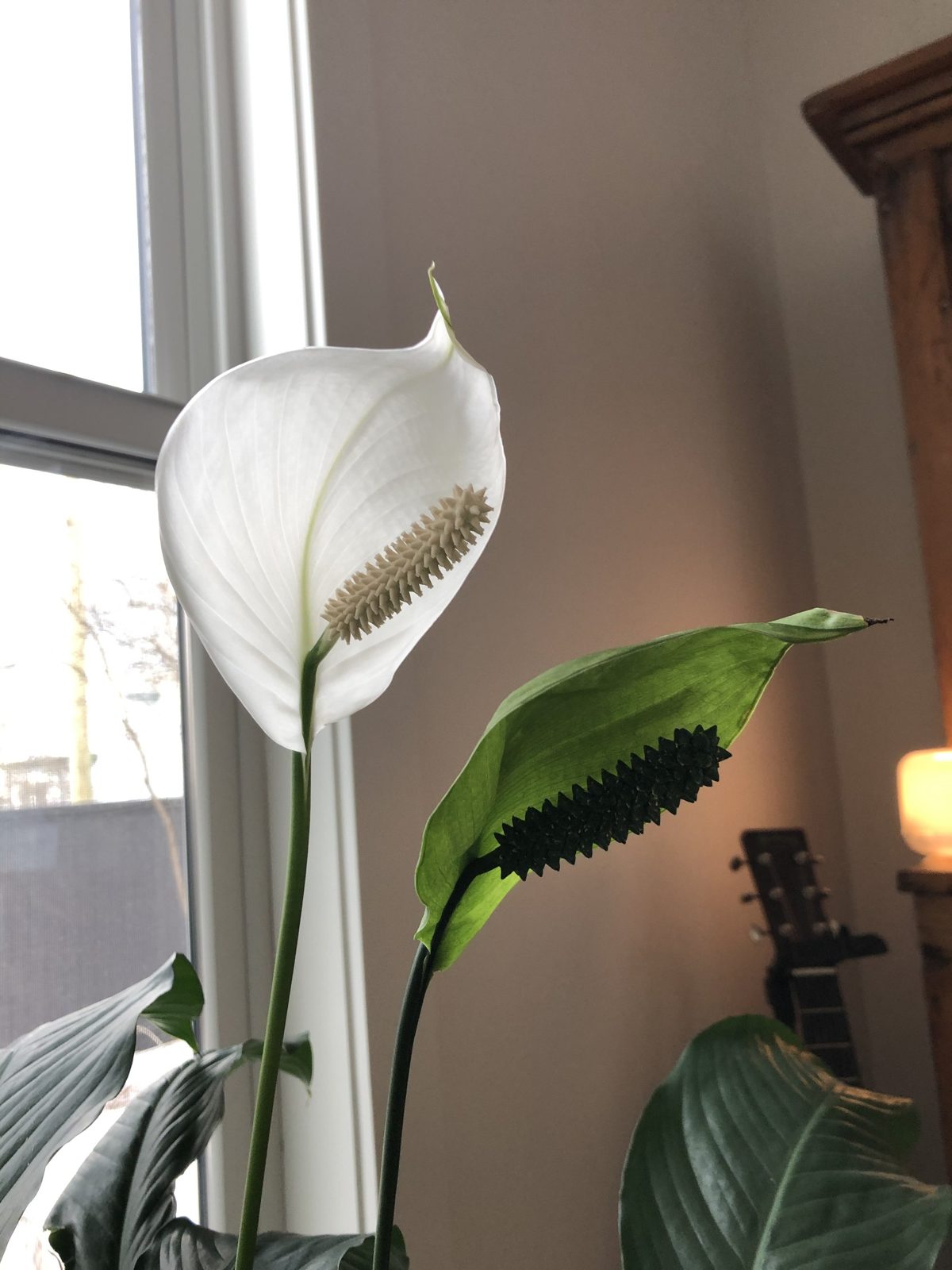
A peace lily that will not bloom almost always needs more light. Move it to bright, indirect light, such as near an east window, and keep the soil evenly moist. Feed it lightly from spring to early fall. A healthy, mature plant then blooms in spring or early summer, and sometimes again in fall.
Peace lilies survive in dim corners, which is why they are sold as low-light plants. They stay green there. They do not flower there.
I earn a commission when you buy through links to Amazon. It costs you nothing extra.
Why it bloomed in the store and not since
This is the part most people are never told. Commercial growers treat peace lilies with a plant hormone called gibberellic acid. It makes the plants flower on schedule, even when they are young, so every pot on the shelf is in bloom.
At home, that treatment wears off. The plant goes back to its own timing. A young plant may not bloom again for a year or more, until it is mature and has the light it needs.
So a peace lily with no flowers after the first round is not a sign you did something wrong.
What the flower is
The white part is not a petal. It is a leaf-like hood called a spathe. The true flowers are the tiny bumps on the spike in the middle, called the spadix.
Each bloom lasts a month or more. It opens white, slowly turns green, and then browns. Green at the end of a bloom’s life is normal.
Step 1: more light
Light is the fix that works most often.
- Best: within 1 m (3 ft) of an east window, or a bright north window.
- Also good: set back 1.5 to 2 m (5 to 6 ft) from a south or west window, or behind a sheer curtain.
- Too dim: a hallway, a far corner, or a bathroom with a small frosted window.
- Too strong: hot direct sun through south or west glass. It bleaches and scorches the leaves.
A simple test: at midday, hold your hand 30 cm (12 in) above the spot. A soft shadow with a blurry edge is about right. No shadow at all is too dim for flowers.
In a northern winter, the days are short and the sun is weak. A peace lily can sit closer to the glass from November to February than it can in summer. Keep the leaves from touching cold windows. If you have no bright window, a grow light for 12 hours a day works. See how to choose a grow light for houseplants and what bright indirect light means for houseplants.
Move the plant in one or two steps, not all at once. Leaves grown in shade can burn if they go straight into strong light.
Step 2: steady water
A peace lily wilts when it is dry and perks up after a drink. It survives this, but a plant that wilts again and again puts its energy into recovery, not flowers.
- Water when the top 2 to 3 cm (1 in) of soil is dry.
- Water until it runs out the bottom, then empty the saucer.
- Do not leave the pot in standing water. Soggy soil rots the roots.
Brown leaf tips are common. They can come from dry air, uneven watering, or salts and fluoride in tap water. If tips keep browning, try rainwater or distilled water, and flush the pot with plain water every month or two. See why is my peace lily drooping if wilting is a regular thing.
Step 3: feed lightly
From March to September, feed with a balanced liquid houseplant fertilizer at half the label strength, every four to six weeks. A liquid houseplant fertilizer from Amazon is fine. No special “bloom booster” is needed.
Do not overdo it. Too much fertilizer gives lots of leaves, brown tips, and flowers that come out green. Stop feeding in winter unless the plant is under a grow light and still growing.
Step 4: warmth and a snug pot
Peace lilies come from tropical forest floors. Keep them at 18 to 27°C (65 to 80°F). Below about 13°C (55°F), growth stalls and leaves can be damaged. Keep the plant away from cold drafts at outside doors and off cold floors in winter.
They also bloom best when the roots are a little crowded. A plant moved into a large pot spends a season growing roots and leaves. Repot only when:
- Roots circle the top of the soil or come out of the drainage holes
- The plant wilts every few days even with good watering
- Water runs straight through
Go up one size, 2 to 5 cm (1 to 2 in) wider. See how to repot a houseplant step by step.
Step 5: clean leaves and old blooms
Dust blocks light. Wipe the leaves with a damp cloth every few weeks, or rinse the plant in the shower with lukewarm water.
When a bloom turns brown, follow its stalk down to the base and cut it there with clean snips. That stalk will not bloom again. Removing it keeps the plant tidy and stops it from making seed.
Step 6: wait for the season
Even with good care, a peace lily blooms on its own calendar. The main flush is in spring and early summer, as the days get longer. Some plants bloom again in fall.
If you raise the light in winter, give it until the next spring before you judge.
Troubleshooting
| What you see | Likely cause | Fix |
|---|---|---|
| Healthy leaves, no flowers | Not enough light | Move to bright, indirect light |
| No flowers in the first year home | Grower’s hormone treatment wore off, plant is young | Good light and time |
| Flowers open green | Too much fertilizer, or low light | Feed less. Raise the light. |
| White flower turns green after weeks | Normal aging | Cut it off when it browns |
| Flowers small and few | Plant is weak or was just divided or repotted | Steady care for a season |
| Brown, crisp flower edges | Dry air or dry soil | Water on time. Raise humidity. |
| Yellow lower leaves | Too much water, or old leaves | Let the top of the soil dry. See why are my houseplant leaves turning yellow. |
| Pale leaves with brown patches | Too much direct sun | Move back from the window |
Peace lily and pets
A peace lily is toxic to cats and dogs. It is not a true lily. The leaves hold sharp calcium oxalate crystals. Chewing them causes mouth pain, drooling, pawing at the mouth, and sometimes vomiting.
Keep it out of reach of pets that chew plants. If your pet eats some, call your vet or a pet poison line.
True lilies (Lilium, including Easter lily) are a different plant and far more dangerous. They can cause kidney failure in cats. For plants that are safe, see best pet-safe houseplants.
Quick checklist
- Bright, indirect light, close to an east or north window
- Soil evenly moist, never soggy
- Half-strength fertilizer every four to six weeks, spring to early fall
- Room at 18 to 27°C (65 to 80°F), no cold drafts
- Pot a little snug
- Leaves wiped clean
- Old flower stalks cut at the base
- One full spring before you judge
If the plant has good light, firm roots, and no flowers after a full year, it may be a variety that blooms less often indoors. It is still a good foliage plant. For plants that flower more freely, see best flowering houseplants that bloom indoors.