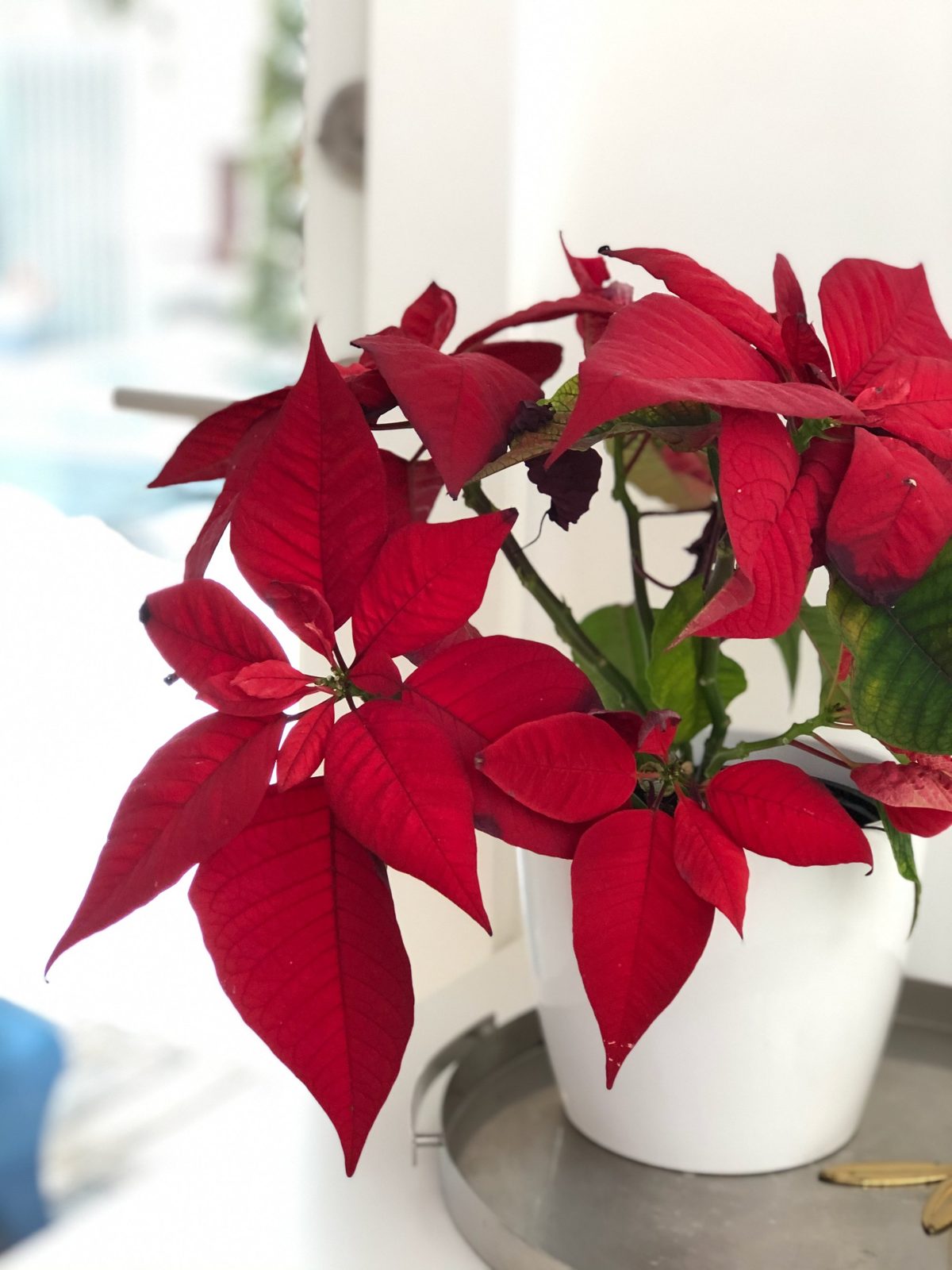
A poinsettia stays alive after Christmas if you give it bright light, steady warmth, and water only when the top of the soil is dry. Take off the foil wrap so the pot can drain, and keep the plant away from cold drafts and heat vents. With that care, it lives for years as a green houseplant.
Getting it red again next winter is a second, harder job. Both are covered below.
What a poinsettia is
A poinsettia (Euphorbia pulcherrima) is a shrub from Mexico. The red, pink, or white parts are not flowers. They are colored leaves called bracts. The real flowers are the small yellow buds in the center.
Stores sell it as a holiday decoration, so most people throw it out in January. It does not have to go.
Care from December to March
Light
Put the plant near a bright window. South, east, or west all work in winter. It needs at least six hours of bright light a day.
Keep the leaves off the glass. A leaf that touches a cold window can be damaged.
Temperature
Poinsettias like the same temperatures people do: 18 to 21°C (65 to 70°F) in the day, a little cooler at night. Below about 10°C (50°F), leaves get damaged and drop.
Keep it away from:
- Outside doors that open to cold air
- Heat vents and baseboard heaters
- Fireplaces and wood stoves
- The top of the TV or other warm electronics
Water
Overwatering kills more poinsettias than anything else. The foil or plastic wrap around the pot holds water like a bucket.
- Take off the wrap, or poke holes in the bottom and set the pot on a saucer.
- Touch the soil every few days. Water when the top 2 cm (1 in) feels dry.
- Water at the sink until it runs out the bottom.
- Let it drain fully before you put it back.
Do not let the plant wilt, either. A poinsettia that dries out hard drops its lower leaves.
Fertilizer
None while it is in color. Start in spring when new growth appears.
Why the leaves are dropping
| What you see | Likely cause | Fix |
|---|---|---|
| Lower leaves yellow and fall | Too much water, or pot sitting in water | Remove the wrap, let the soil dry at the top |
| Leaves wilt and fall, soil dry | Too little water | Water fully and check more often |
| Leaves drop soon after you bring it home | Cold on the trip home | Keep it warm and wait |
| Leaves curl and brown at the edges | Heat vent or dry air | Move it away from the heat |
| Leaves drop from one side | Cold draft or cold glass | Move it back from the window or door |
A poinsettia that got cold on the way home may drop leaves no matter what you do. See how to buy houseplants in winter and get them home alive for next year.
Spring: cut it back
By March or April, the bracts fade and fall. The plant looks bare. This is normal.
- Cut each stem back to about 15 cm (6 in) tall. Leave two or three leaf nodes on each stem.
- Wear gloves. The stems leak a milky white sap that can irritate skin. Wash it off with soap and water.
- Keep the plant in a bright window and water a little less until new shoots show.
- Once it is growing, repot it into a pot one size larger with fresh indoor potting mix. See how to repot a houseplant step by step.
- Start a balanced houseplant fertilizer every two to four weeks, following the label.
Summer: grow it on
A poinsettia grows fast in summer. It can spend the season outdoors once nights stay above 10°C (50°F). Put it in morning sun and afternoon shade, and move it out in stages so the leaves do not burn. How to move houseplants outside for summer without sunburn explains the steps.
Pinch the tips of the new shoots once or twice before the end of August. To pinch, snip off the top 2 to 3 cm (1 in) of each stem. This makes the plant branch, and more branches mean more color in winter.
Bring it back inside before nights drop to 10°C (50°F). Check it for bugs first. Whiteflies are fond of poinsettias. See how to get rid of whiteflies on houseplants.
Fall: how to make it turn red again
A poinsettia colors up in response to long nights. It needs about 14 hours of complete, unbroken darkness every night for 8 to 10 weeks.
- Start around October 1.
- Each evening at about 5 pm, put the plant in full darkness. A closet, a cupboard, or a large box turned over the plant all work.
- Each morning at about 7 am, bring it back to a bright window.
- Keep watering and feeding as normal.
- Do this every night until the bracts show good color, usually late November or early December. Then stop and leave it in the window.
The darkness has to be complete. A lamp, a hallway light under the closet door, or a streetlight through a window can delay or stop the color. A missed night or two sets the plant back.
Night temperatures of about 16 to 18°C (60 to 65°F) help.
Be honest about the result
A poinsettia you rebloom at home will not look like one from the store. Commercial growers use greenhouses with exact light control and growth regulators that keep the plants short and full. A home plant is often taller and looser, with smaller bracts. It is still a nice plant.
If the dark routine is too much, keep it as a green shrub. It makes a good one.
Is a poinsettia safe for pets and kids?
A poinsettia is toxic to cats and dogs, though it is milder than its reputation. The milky sap irritates the mouth and stomach. A pet that chews it may drool or vomit.
Keep it out of reach of pets that chew plants. If your pet eats some, call your vet or a pet poison line.
Other holiday plants carry more risk. True lilies (Lilium), sometimes used in winter bouquets, are dangerous to cats. Even a small amount can cause kidney failure. Amaryllis is also toxic to cats and dogs. Christmas cactus is non-toxic. See what “toxic to pets” means for a houseplant.
When to let it go
Keep it if the stems are firm and there are green leaves or buds on them, even a few.
Let it go if:
- The stems are soft, black, or shriveled at the base
- The roots are brown and mushy and smell bad
- Every leaf has dropped and the stems are dry and brittle all the way down
Composting a holiday plant is a fair choice. If you want a winter bloomer that comes back each year with less work, a Christmas cactus is the simpler choice.
The year in short
- December to March: bright light, 18 to 21°C (65 to 70°F), water when the top is dry.
- March or April: cut back to 15 cm (6 in).
- May: repot and start fertilizer.
- June to August: grow in bright light, pinch the tips.
- September: bring it inside.
- October 1 to late November: 14 hours of full darkness each night.
- December: enjoy the color.