Monstera care guide
Monstera deliciosa, also called Swiss cheese plant, split-leaf philodendron
Published 2026-10-19
Quick care
- Light
- Bright indirect
- Water
- When the top 5 cm (2 in) of soil is dry
- Humidity
- Average room air is fine. More helps new leaves open.
- Temperature
- 18 to 29°C (65 to 85°F). Keep above 12°C (55°F).
- Soil
- Chunky mix: potting soil, orchid bark, and perlite
- Feeding
- Balanced liquid fertilizer, monthly in spring and summer
- Pets
- Toxic to cats and dogs if chewed
- Difficulty
- Moderate
- Mature size
- 2 to 3 m (6 to 10 ft) tall indoors with support
- Propagation
- Stem cuttings with a node
Monstera is the big, split-leaf plant everyone wants. It is not hard to grow. It does need room, a bright spot, and something to climb.
Light
Give monstera bright, indirect light. A spot near an east window or a few feet back from a south or west window works well.
Light decides whether leaves split. In low light, new leaves stay small and solid. Hot afternoon sun through glass burns the leaves.
Water
Water when the top 5 cm (2 in) of soil is dry. Water slowly until it drains out the bottom, then empty the saucer.
In summer that is often once a week. In winter it may be every two to three weeks. Read how to tell if a houseplant is overwatered or underwatered.
Soil and potting
Monstera roots want air. Mix potting soil with orchid bark and perlite, about one third each.
Repot every one to two years in spring, one pot size up. This is also the time to add a moss pole or a stake. See how to repot a houseplant step by step.
Support
Monstera is a climber. In the wild it grows up tree trunks. Indoors, a moss pole or a sturdy stake keeps it upright and helps it grow bigger leaves.
Tie the main stem loosely to the pole with soft plant ties. Tuck the long brown aerial roots against the pole or into the soil. Cutting a few off does no harm.
Humidity and temperature
Average room air is fine. Higher humidity helps new leaves unfurl without tearing. Keep the plant away from heating vents and cold drafts.
Feeding
Feed monthly in spring and summer with a balanced liquid fertilizer. Skip it in fall and winter.
Pruning
Cut off yellow or damaged leaves at the base of the leaf stem. To control height, cut the main stem just above a node. A new shoot grows from below the cut.
Propagation
Every cutting needs a node, the bump on the stem where a leaf and an aerial root grow. A leaf with no node never grows a new plant.
Cut 2 cm (1 in) below a node. Root it in water or damp sphagnum moss. Roots appear in two to four weeks. Pot it once the roots are 5 to 8 cm (2 to 3 in) long.
Problems
| What you see | Most likely cause |
|---|---|
| Leaves not splitting | Not enough light, or the plant is still young |
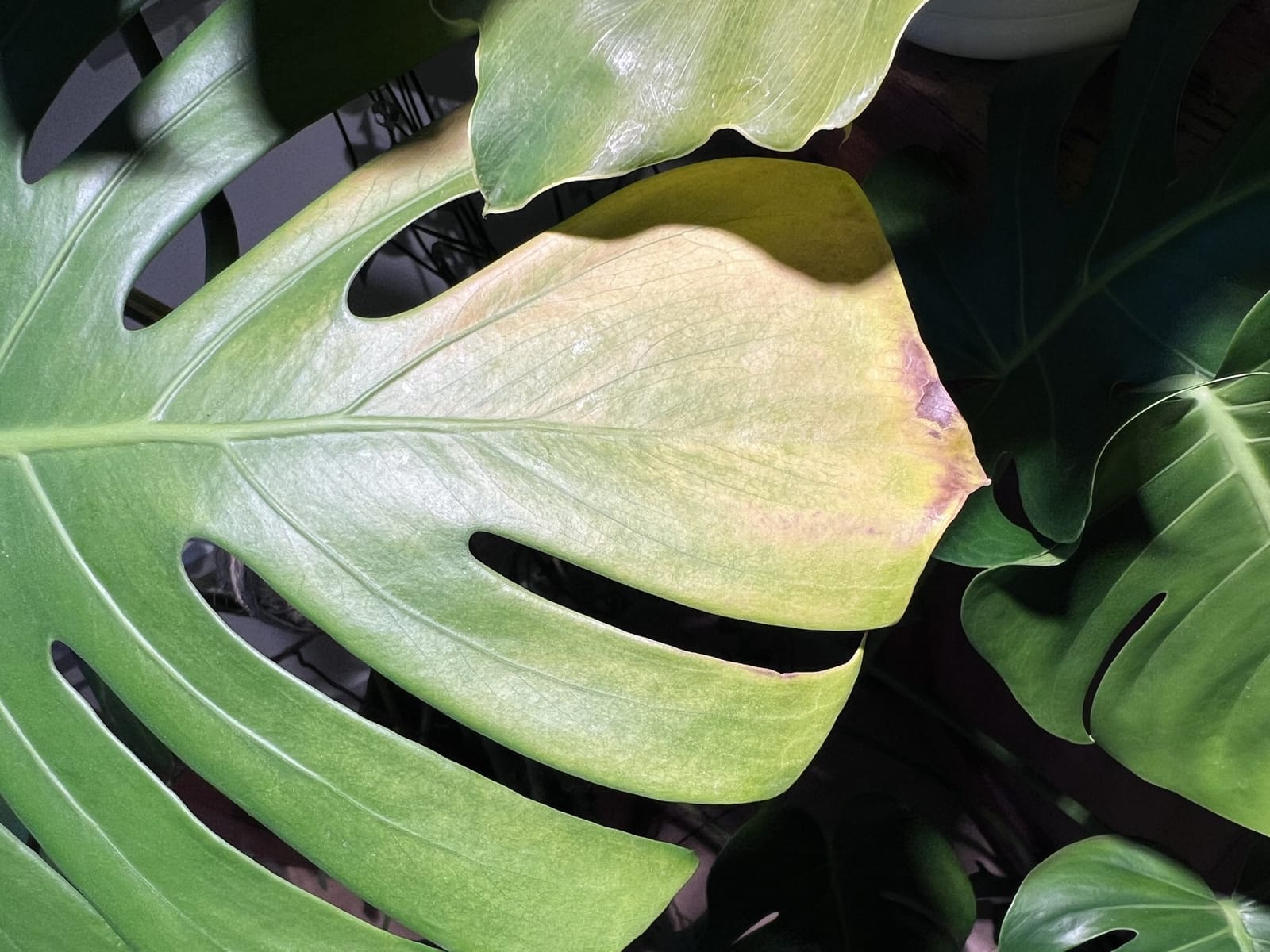
| Yellow lower leaves, wet soil | Too much water |
| Brown crispy edges | Dry soil or very dry air |
| Brown patches in the middle of leaves | Sunburn |
| Leaning, floppy stems | Needs support |
| Drops of water on leaf tips | Guttation, normal after watering |
Pests
Watch for spider mites, thrips, and mealybugs, mostly on new leaves. Wipe the leaves now and then so you notice problems early. Fungus gnats mean the soil stays wet too long. Read how to get rid of fungus gnats in houseplants.
Pet safety
Monstera is toxic to cats and dogs. Chewing the leaves irritates the mouth and can cause drooling and vomiting.
Varieties
- ‘Thai Constellation’ has creamy speckles all over the leaves.
- ‘Albo Variegata’ has bold white sections and costs much more.
- Monstera adansonii is a different species, with smaller leaves full of holes.
In my house
My monstera spends the summer outside, the same as my snake plants. The trouble is that it is heavy. Sometimes I do not get it into the shade right away, and the leaves go brown and shrivel in the direct sun. Do not do this. Put it in the shade the day it goes outside.