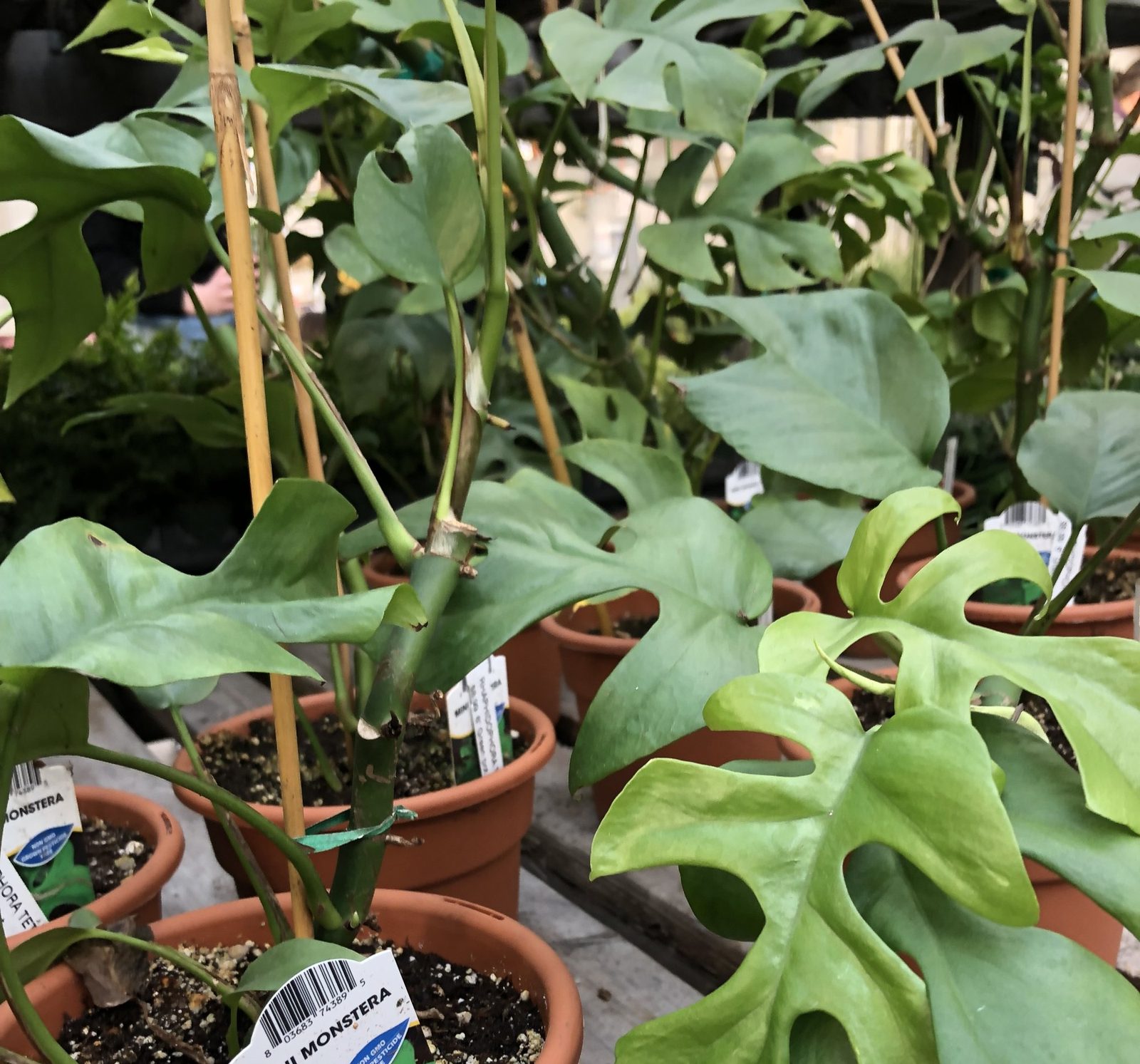
Most plants sold as “split-leaf” are one of four: monstera, mini monstera, tree philodendron, or ‘Xanadu’. Monstera has holes inside the leaf as well as splits at the edge. Mini monstera has small leaves with splits and few or no holes. Tree philodendron and ‘Xanadu’ have deeply lobed leaves with wavy edges and no holes at all.
The name “split-leaf philodendron” gets used for both monstera and tree philodendron. They are different plants. One climbs and one forms a trunk. Check the leaf and the stem and you can sort any of them in a minute.
The quick comparison
| Plant | Leaf size | Holes | Edge | How it grows |
|---|---|---|---|---|
| Monstera deliciosa | 30 to 90 cm (1 to 3 ft) | Yes, on mature leaves | Smooth lobes | Climbs with thick aerial roots |
| Swiss cheese vine | 10 to 25 cm (4 to 10 in) | Yes, many | Whole, not split | Thin trailing or climbing vine |
| Mini monstera | 10 to 20 cm (4 to 8 in) | Few or none | Deep splits | Thin, fast climbing vine |
| Dragon tail | 15 to 40 cm (6 to 16 in) | No | Splits with age | Climbing vine |
| Tree philodendron | 60 to 100 cm (2 to 3 ft) | No | Deep, wavy lobes | Upright, forms a trunk |
| ‘Xanadu’ | 20 to 40 cm (8 to 16 in) | No | Many finger-like lobes | Low, wide clump |
| Bird of paradise | 45 cm (18 in) or more | No | Tears along the veins | Upright fan |
All of these are toxic to cats and dogs. The aroids on this list hold calcium oxalate crystals that cause mouth pain, drooling, and vomiting. If a pet chews one, call your vet or a pet poison line.
Holes, splits, and lobes
Three words get mixed together. They mean different things.
- Holes are openings inside the leaf, closed all the way around. The term for them is fenestrations.
- Splits are cuts that run from the edge toward the center rib. On a monstera, a split often starts as a hole that reaches the edge as the leaf grows.
- Lobes are fingers of leaf with wavy or rounded outlines. The leaf grows in that shape from the start.
Holes mean monstera or its close relatives. Wavy lobes with no holes mean tree philodendron or ‘Xanadu’.
Monstera deliciosa
Monstera (Monstera deliciosa) is the plant on every poster and pillow. A mature leaf is a broad heart with deep splits along the edge and one or more rows of oval holes near the center rib. The surface is glossy and leathery.
Young plants have small, whole, heart-shaped leaves. Splits come first, then holes, as the plant ages and gets more light. If yours has stayed plain, read why is my monstera not splitting.
How to know it:
- Thick green stems with long, brown, cord-like aerial roots
- A wrinkled joint where the leaf stalk meets the leaf blade
- Holes inside the leaf on mature growth
- A climbing habit that leans and sprawls without a pole
‘Thai Constellation’ and ‘Albo’ are variegated forms of the same plant, with cream or white marks.
Swiss cheese vine
Swiss cheese vine (Monstera adansonii) has much smaller leaves full of oval holes. The edge of the leaf stays whole. The holes do not break through to make splits. Stems are thin, and the plant trails from a basket or climbs a pole. If the leaf is more hole than leaf and the edge is intact, this is the plant.
Mini monstera
Mini monstera (Rhaphidophora tetrasperma) is not a monstera. It is a different genus in the same family. The leaves are 10 to 20 cm (4 to 8 in) long with deep splits on each side, and they are thinner and less glossy than monstera leaves. Most have no inner holes, though a mature leaf can have a few small ones.
It grows fast on a thin vine and needs a stake or pole from the start. Even young plants have split leaves, which is the fastest way to tell it from a young monstera.
Dragon tail
Dragon tail (Epipremnum pinnatum) is a close relative of pothos. Young leaves are narrow and whole. As the vine climbs, the leaves grow larger and develop deep splits along both sides. ‘Cebu Blue’ is a silvery blue form. On a trailing plant the leaves stay small and uncut. It needs a pole to show splits.
Tree philodendron
Tree philodendron (Thaumatophyllum bipinnatifidum) is the other plant sold as “split-leaf philodendron.” You may also see it labeled Philodendron selloum or ‘Hope’. The leaves are huge and deeply lobed, with ruffled, wavy edges. They have no holes.
How to tell it from monstera:
- Edges: tree philodendron lobes are wavy and ruffled. Monstera lobes are smooth and flat.
- Holes: tree philodendron has none.
- Stem: tree philodendron grows from a central point and forms a thick, upright trunk marked with pale, eye-shaped leaf scars. Monstera has a vining stem.
- Shape: tree philodendron grows as a wide rosette. Monstera climbs or sprawls in one direction.
‘Xanadu’
‘Xanadu’ (Thaumatophyllum xanadu) is a smaller relative of tree philodendron. Each leaf has many narrow, finger-like lobes and a glossy surface. The plant stays low and grows wider than tall. It suits a spot where a tree philodendron would not fit. See types of philodendron houseplants for more of the family.
Bird of paradise
Bird of paradise (Strelitzia) is not a split-leaf plant, but its leaves split. The big paddle-shaped leaves tear along the side veins from wind, handling, and age. The tears run straight from the edge to the center rib, with no holes and no lobes. This is normal. It is not a sign of poor care.
A three-step test
- Look for holes. Holes inside the leaf mean a monstera. Large leaf with holes and splits: Monstera deliciosa. Small leaf with holes and a whole edge: Swiss cheese vine.
- Look at the edge. Wavy, ruffled lobes mean tree philodendron or ‘Xanadu’. Clean, straight splits on a small leaf mean mini monstera or dragon tail.
- Look at the stem. A vine with roots along it climbs. A short central trunk or clump does not.
Care they share
The climbers and the upright types want much the same conditions.
- Light: bright indirect light. Low light gives small leaves with fewer splits.
- Water: water when the top half of the soil is dry.
- Soil: a chunky mix of 2 parts potting mix, 1 part orchid bark, and 1 part perlite.
- Support: give the climbers a pole. Leaves get larger and more split as the vine climbs. See how to use a moss pole for climbing houseplants.
- Warmth: keep them above 15°C (60°F) and back from cold winter glass.
Which one fits your space
- Small apartment: mini monstera or Swiss cheese vine
- A corner with a pole: Monstera deliciosa
- A wide, empty floor space: tree philodendron
- A low spot under a window: ‘Xanadu’
- A sunny room with a high ceiling: bird of paradise
If you want the look but not these exact plants, see indoor plants like monstera.