Philodendron houseplants come in three types: vining, upright, and crawling. Vining types trail or climb, such as heartleaf philodendron. Upright types grow from a central clump, such as ‘Birkin’. Crawling types creep along the soil, such as Philodendron gloriosum. Once you know which type you have, you know what pot and support it needs.
All philodendrons are toxic to cats and dogs. The leaves hold tiny calcium oxalate crystals that cause mouth pain, drooling, and vomiting. If a pet chews one, call your vet or a pet poison line.
The quick comparison
| Philodendron | Type | Leaf | Light |
|---|---|---|---|
| Heartleaf | Vining | Small green hearts | Low to bright indirect |
| ‘Brasil’ | Vining | Hearts with a lime stripe | Medium to bright indirect |
| ‘Micans’ | Vining | Velvet hearts with a bronze sheen | Medium to bright indirect |
| ‘Lemon Lime’ | Vining | Yellow-green hearts | Medium to bright indirect |
| ‘Pink Princess’ | Climbing | Dark leaves with pink patches | Bright indirect |
| Philodendron melanochrysum | Climbing | Long, dark velvet leaves | Bright indirect |
| Philodendron brandtianum | Vining | Olive hearts with silver bands | Medium to bright indirect |
| ‘Birkin’ | Upright | Green with white pinstripes | Bright indirect |
| ‘Prince of Orange’ | Upright | New leaves open orange | Bright indirect |
| ‘Imperial Green’ | Upright | Broad, glossy, deep green | Medium to bright indirect |
| ‘Xanadu’ | Upright | Many-lobed, glossy | Bright indirect |
| Tree philodendron | Upright | Huge, deeply cut | Bright indirect |
| Philodendron gloriosum | Crawling | Velvet hearts with white veins | Bright indirect |
Vining and climbing philodendrons
These grow one long stem with a leaf at each joint. They trail from a shelf or climb a pole. On a pole, the leaves get larger with each new one.
Heartleaf philodendron
Heartleaf philodendron (Philodendron hederaceum) is the one most people own. The leaves are thin, matte, and shaped like a heart with a long tip. They are 5 to 10 cm (2 to 4 in) long on a trailing plant. It takes low light better than almost any other vine. It is often mixed up with pothos. See pothos vs philodendron for the tells.
‘Brasil’
‘Brasil’ is a heartleaf with a lime or yellow stripe down the center of each leaf. No two leaves match. It needs medium to bright indirect light to keep the stripe. In a dim spot the new leaves come in plain green. Read why variegated houseplants turn green for the fix.
‘Micans’
‘Micans’ is a velvet form of heartleaf philodendron. The leaves are dark green with a bronze or purple sheen, and the undersides are reddish. It likes a bit more humidity than the plain green type. The leaf edges brown in furnace-dry air.
‘Lemon Lime’
‘Lemon Lime’ is a heartleaf with solid yellow-green leaves. New leaves open pinkish yellow and settle to lime. It is easy to confuse with ‘Neon’ pothos. The philodendron has thinner leaves and a papery sheath on new growth.
‘Pink Princess’
‘Pink Princess’ is a form of Philodendron erubescens. The leaves are dark green to near black with patches of bright pink. It is a slow climber and wants a stake or pole. Give it bright indirect light. If a stem makes several all-green leaves in a row, cut it back to the last leaf that showed pink.
Philodendron melanochrysum
This climber has long, narrow, velvet leaves that are dark green with pale veins. On a moss pole in humid air, mature leaves can pass 60 cm (2 ft) long. It is a plant for someone ready to run a humidifier. See how to use a moss pole for climbing houseplants.
Philodendron brandtianum
Sometimes sold as silver leaf philodendron. The leaves are olive green hearts with wide silver bands between the veins. It trails or climbs and stays a manageable size. Care is the same as for heartleaf.
Upright philodendrons
These are called self-heading types. The leaves come from a short central stem, and the plant grows as a clump. They do not need a pole. They need floor or table space.
‘Birkin’
‘Birkin’ has dark green leaves with thin white or cream pinstripes. New leaves open nearly white and darken with age. It stays under 60 cm (2 ft) for years, so it suits a table. Now and then a leaf comes in half red or all green. That is normal for this plant.
‘Prince of Orange’
New leaves open bright orange, fade to copper, and end up green. A healthy plant shows all three colors at once. Bright indirect light keeps the orange strong.
‘Imperial Green’ and ‘Imperial Red’
These two have broad, glossy, paddle-shaped leaves in a tidy rosette. ‘Imperial Green’ is deep green. ‘Imperial Red’ opens dark red and ages to green with a red tint. Both take medium light and are among the easiest upright types.
‘Xanadu’
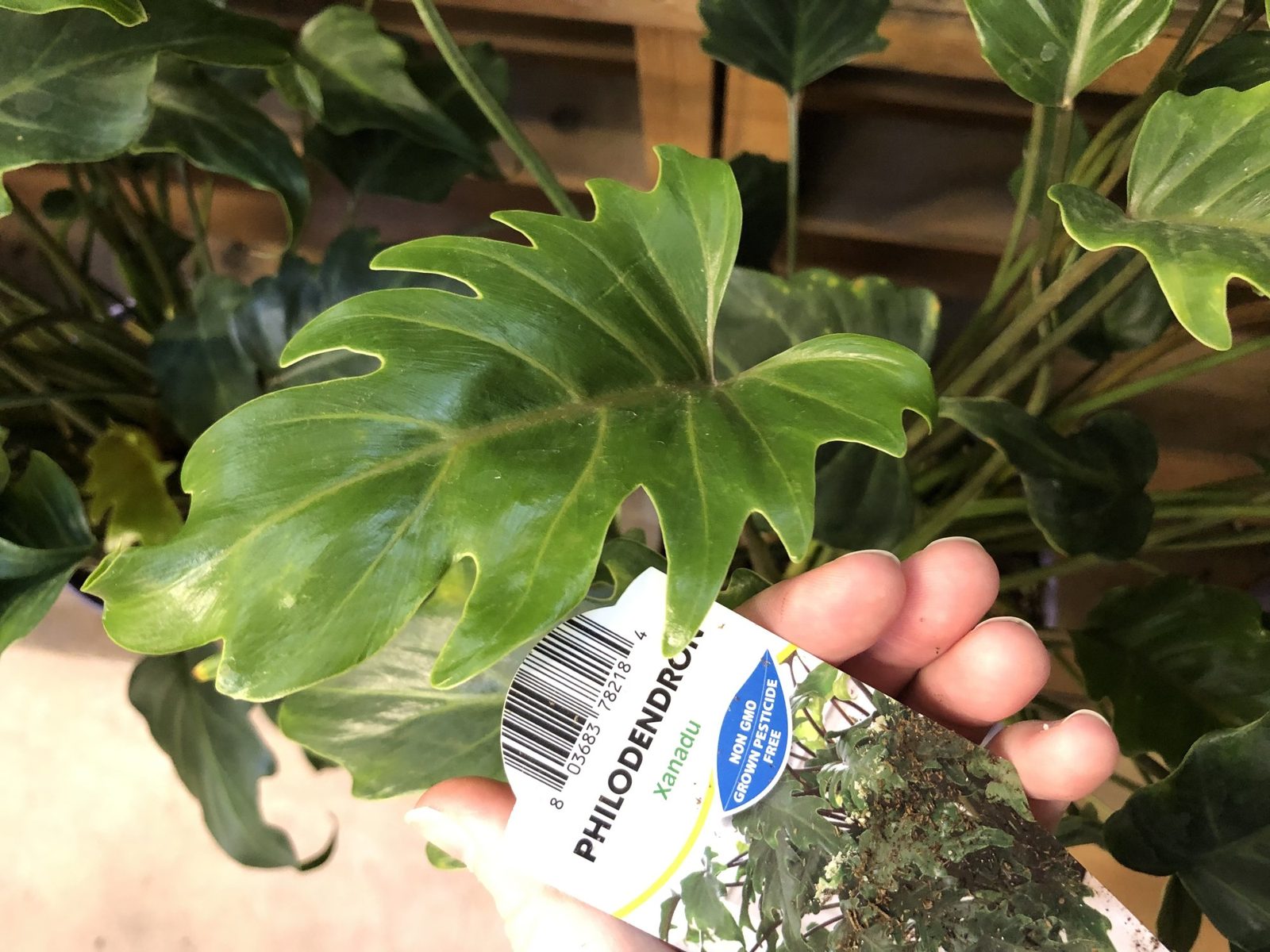
‘Xanadu’ has glossy leaves with many finger-like lobes. It grows wider than tall, to about 1 m (3 ft) across. Botanists have moved it to a new genus, so the tag may read Thaumatophyllum xanadu. Stores still sell it as a philodendron, and care is the same.
Tree philodendron
Tree philodendron (Thaumatophyllum bipinnatifidum, once Philodendron selloum) is the giant of the group. The leaves are deeply cut and can reach 1 m (3 ft) long on a mature plant. It forms a thick trunk with age. Give it 1 m (3 ft) of space on every side. ‘Hope’ is a smaller form.
Crawling philodendrons
Philodendron gloriosum
This plant has large, velvet, heart-shaped leaves with white veins. Its stem does not climb. It creeps along the top of the soil and sends up one leaf at a time. Plant it in a long, shallow pot and let the stem lie on the surface. Do not bury the stem, since it rots under the soil.
Plants sold as philodendron that are not
- Split-leaf philodendron: this name is often used for monstera (Monstera deliciosa). A monstera has holes inside the leaf as well as splits at the edge.
- Mini monstera: Rhaphidophora tetrasperma is neither a monstera nor a philodendron.
- Pothos: Epipremnum aureum has thicker, waxier leaves and no sheath on new growth.
See split-leaf houseplants and how to tell them apart for the full comparison.
Care all philodendrons share
- Light: bright indirect light is best. Green types take lower light. Colored and velvet types need more.
- Water: water when the top half of the soil is dry. Yellow lower leaves usually mean too much water.
- Soil: a chunky mix of 2 parts potting mix, 1 part orchid bark, and 1 part perlite.
- Temperature: keep them above 15°C (60°F). Move them back from cold window glass in winter.
- Humidity: normal room air suits green types. Velvet types want 50 percent or more.
For the full guide, read the philodendron care page.
Which type to pick
- First philodendron: heartleaf or ‘Brasil’.
- Low light: plain green heartleaf.
- A table or desk: ‘Birkin’ or ‘Imperial Green’.
- A big empty corner: tree philodendron or ‘Xanadu’.
- A pole to climb: ‘Pink Princess’ or Philodendron melanochrysum.
- A home with pets: none of them. See indoor plants like pothos for pet-safe vines with a similar look.