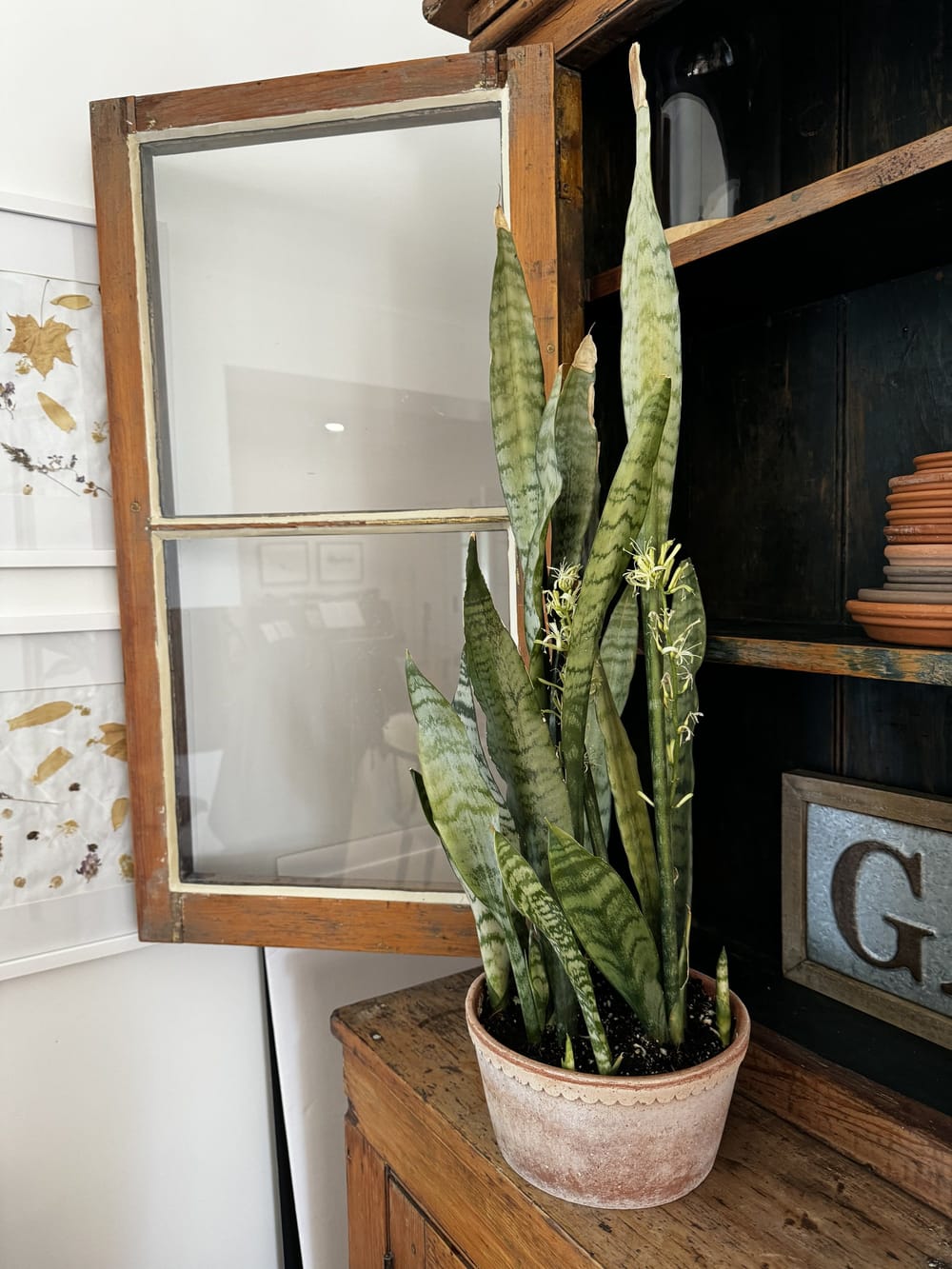
Snake plant leaves fall over most often because of too much water. The base of the leaf rots and can no longer hold the weight. Low light is the second cause, and a top-heavy plant in a loose pot is the third. Squeeze the leaf where it meets the soil. A soft base means rot. A firm base means light or balance.
A leaf that has bent or creased does not stand back up. The fix is to stop the cause, then stake, trim, or replant the leaves that fell.
I earn a commission when you buy through links to Amazon. It costs you nothing extra.
Find the cause fast
| What you see | Most likely cause |
|---|---|
| Leaf base is soft, mushy, or smells bad | Root rot from too much water |
| Leaves are firm but long, thin, and leaning to the window | Not enough light |
| Tall, firm leaves tip outward, or the whole plant rocks in the pot | Top-heavy, or loose soil |
| Leaves are wrinkled, thin, and folding inward | Too little water |
| Limp, see-through patches after a cold night | Cold damage |
| Leaves flopped right after repotting | Planted too shallow, or soil not firmed |
Too much water
A snake plant stores water in its leaves and in thick stems under the soil. It needs far less water than most houseplants. Soil that stays wet rots the roots first, then the base of each leaf.
Signs of rot:
- Leaves fold over at the soil line
- The base is yellow, brown, soft, or slimy
- A leaf pulls out with a light tug
- The soil smells sour
What to do.
- Slide the plant out of the pot.
- Shake off the wet soil.
- Cut off every root and leaf base that is brown and mushy. Use a clean knife. Firm, pale orange or white roots are healthy.
- Let the plant sit bare for a day so the cuts dry.
- Repot in dry cactus and succulent mix, in a pot with a drainage hole.
- Wait a week before you water.
A bag of cactus and succulent potting mix from Amazon drains faster than regular potting soil. Regular soil mixed half and half with perlite also works.
After that, water only when the soil is dry all the way down. Push a wooden skewer to the bottom of the pot. If it comes out clean and dry, water. In most homes that is every two to four weeks in summer and every four to eight weeks in winter.
More help is in what causes root rot in houseplants and how to fix it.
Cold and wet together
In a cold-winter climate, snake plants rot fastest in winter. The plant sits by a cold window, it grows little, and the soil stays wet for weeks. Cold and wet together cause rot fast.
Move the pot back from the glass in winter. Keep it above 10°C (50°F). Water less often than feels right. A leaf that touched freezing glass turns limp and see-through, and it does not recover. Cut it off at the soil line.
Not enough light
Snake plants survive in low light. They do not stay upright there. New leaves grow long, narrow, and soft as they reach for light, and then they lean or flop.
The leaf base is firm in this case. The soil is not soggy. The whole plant tilts toward the nearest window.
What to do. Move it closer to a window with bright, indirect light. Make the move in steps over a week or two. A plant that goes from a dim corner straight into sun can scorch. Turn the pot a quarter turn each time you water so it grows straight. Why houseplants lean toward the window and how to fix it explains more.
The stretched leaves stay stretched. New leaves grow in shorter and stiffer.
Top-heavy or loose in the pot
Tall types can reach 120 cm (4 ft). The roots are shallow. A big plant in a light plastic pot, or in loose soil, tips outward under its own weight.
This also happens right after repotting. The soil has not settled, and the leaves have nothing to grip.
What to do.
- Firm the soil around the base with your fingers.
- Set the plant a little deeper, with the soil 1 to 2 cm (about ½ in) up the base of the leaves.
- Move it to a heavier pot. A terracotta pot with a drainage hole adds weight and helps the soil dry.
- Keep the pot snug. Snake plants hold themselves up better when the roots fill the pot.
- Loop soft plant tie or twine around the whole clump for a few months while the roots anchor.
See how to keep tall houseplants from falling over for more ways to steady a pot.
Too little water
It is rare, but a snake plant left dry for months gets thin and wrinkled. The leaves curl inward along their length and can bend.
The soil is dust dry and the pot is light. Water well, let it drain, and the leaves plump up again over a week or two.
What to do with a leaf that fell
A bent leaf has a crease that does not heal. You have three choices.
- Stake it. If the base is firm and the leaf only leans, tie it to a thin bamboo stake.
- Cut it off. Cut at the soil line with a clean knife. The plant fills the gap with new leaves from the base.
- Root it. Cut the firm, healthy part of the leaf into 8 cm (3 in) pieces and root them in soil. How to propagate a snake plant has the steps.
Do not root any piece that is soft or brown. Rot spreads.
A note on pets
Snake plants are mildly toxic to cats and dogs. Chewing the leaves can cause drooling, vomiting, and diarrhea. A fallen leaf on the floor is easier for a pet to reach, so pick it up. Call your vet or a pet poison line if a pet eats some.
When to start over
If every leaf is soft at the base and the roots are all brown, the plant cannot be saved whole. Cut the firm upper parts of the leaves and root them as cuttings. Throw out the old soil, and wash the pot in hot, soapy water before you reuse it.
A quick checklist
- Squeeze the base of the fallen leaf
- Soft base: unpot, cut out rot, repot in dry cactus mix
- Firm base: move to brighter light and firm the soil
- Water only when the soil is dry to the bottom
- Keep it off cold windowsills in winter
- Use a snug, heavy pot with a drainage hole