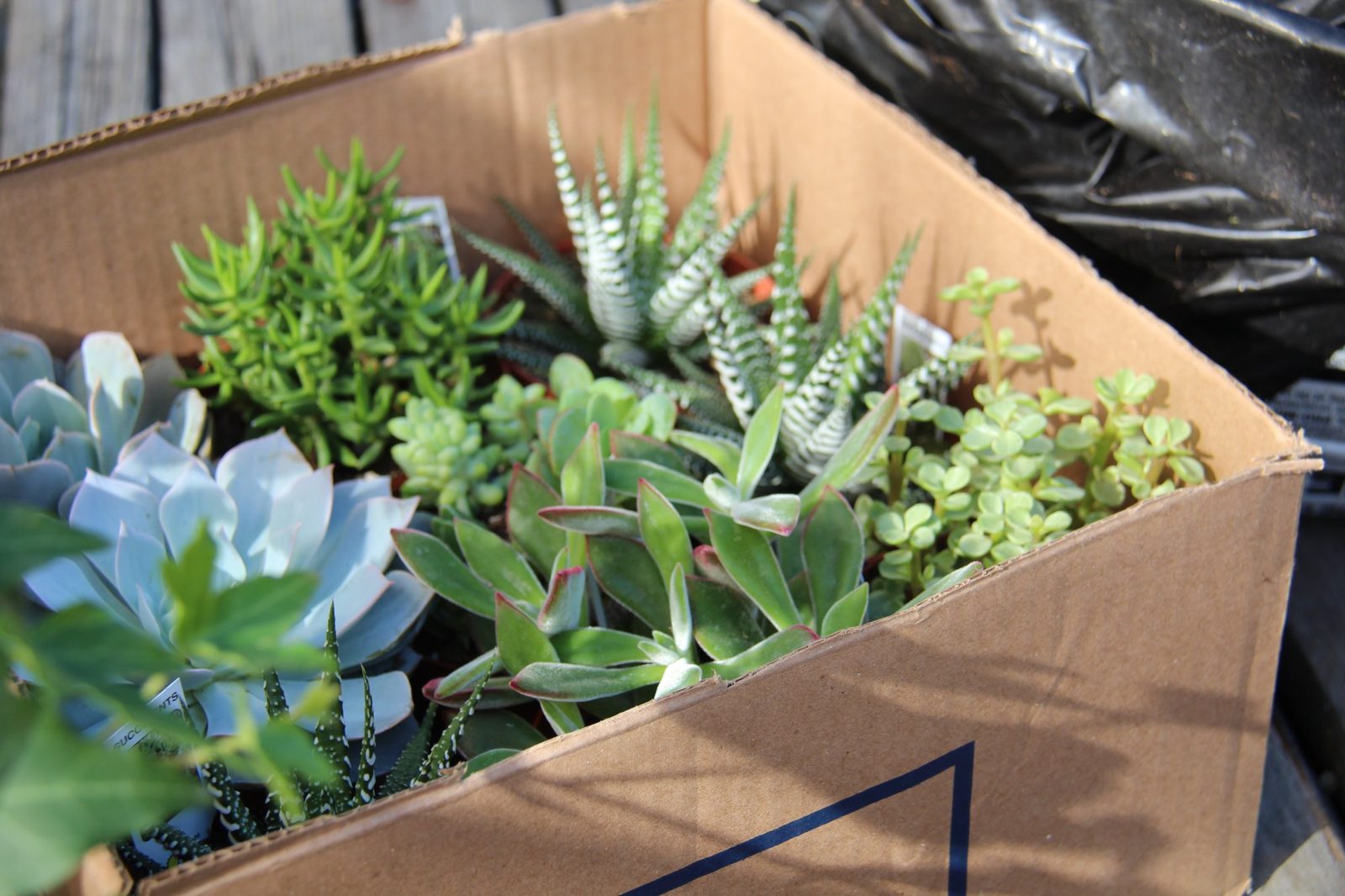
The most common succulent houseplants are echeveria, haworthia, aloe vera, jade plant, burro’s tail, string of pearls, kalanchoe, and snake plant. To tell them apart, look at three things: the shape the plant grows in (rosette, shrub, or trailing), the leaf shape, and the leaf surface. Most mix-ups come down to three pairs, and each pair has one clear tell.
A succulent is any plant that stores water in thick leaves, stems, or roots. It is a description, not a family. That is why succulents look so different from each other, and why a few need different care.
I earn a commission when you buy through links to Amazon. It costs you nothing extra.
The 12 plants at a glance
| Plant | Shape | Key feature | Pet safe |
|---|---|---|---|
| Echeveria | Flat rosette | Plump, spoon-shaped leaves with a powdery coat | Yes |
| Hens and chicks | Flat rosette | Thin, pointed leaves with fine hairs on the edges | Yes |
| Zebra haworthia | Spiky rosette | Dark leaves with raised white bands | Yes |
| Aloe vera | Upright rosette | Long, gel-filled leaves with soft teeth | No |
| Jade plant | Small tree | Oval, glossy leaves on thick stems | No |
| Elephant bush | Small shrub | Tiny round leaves on red-brown stems | Yes |
| Burro’s tail | Trailing | Ropes of plump, blue-green leaves | Yes |
| String of pearls | Trailing | Round, pea-like leaves on thin stems | No |
| Kalanchoe | Upright clump | Scalloped leaves and flower clusters | No |
| Snake plant | Upright blades | Stiff, sword-shaped leaves | No |
| Living stones | Pebble | One pair of fused leaves with a slit | Yes |
| Christmas cactus | Arching | Flat, jointed stem segments, no real leaves | Yes |
Pair 1: echeveria or hens and chicks
Both grow as flat rosettes that look like green flowers. They are sold side by side, and the tags often just say “succulent.”
Echeveria comes from Mexico and Central America.
- Leaves are thick, plump, and spoon-shaped.
- Many have a pale, powdery coating that rubs off under a finger.
- Leaf edges are smooth.
- Flowers are bell-shaped, on a tall arching stalk that grows from the side of the rosette. The plant lives on after it blooms.
- It is not frost hardy. It is a houseplant in a cold climate.
Hens and chicks (Sempervivum) comes from the mountains of Europe.
- Leaves are thinner and flatter, and they end in a sharp point.
- Leaf edges have a fringe of tiny hairs. Look closely or use a magnifier.
- Baby plants grow on short runners all around the mother.
- The flower stalk grows from the center of the rosette, and that rosette dies after it blooms.
- It is frost hardy and belongs outdoors. It struggles on a warm indoor sill.
The tell: check the leaf edge. Tiny hairs mean hens and chicks. A smooth edge and a plump leaf mean echeveria.
Pair 2: haworthia or aloe
Both grow as spiky rosettes of pointed leaves. They are close relatives.
Zebra haworthia (Haworthiopsis attenuata):
- Stays small, about 10 to 15 cm (4 to 6 in) tall.
- Leaves are dark green, stiff, and marked with raised white bumps or bands.
- Leaf edges have no teeth.
- Handles bright indirect light.
- It is safe for cats and dogs.
- Grows much bigger, 30 to 60 cm (1 to 2 ft) tall.
- Leaves are gray-green, thick, and full of clear gel. Young plants have pale flecks that fade with age.
- Leaf edges have small, soft teeth.
- Wants direct sun for part of the day.
- It is toxic to cats and dogs when eaten.
The tell: run a finger along the leaf edge. Teeth mean aloe. Raised white bands and no teeth mean haworthia.
Pair 3: jade plant or elephant bush
Both are small, woody shrubs with round, fleshy leaves. They are not related.
Jade plant (Crassula ovata):
- Leaves are 2.5 to 5 cm (1 to 2 in) long, oval, thick, and glossy.
- Stems are thick and green, turning brown and trunk-like with age.
- Leaves grow in opposite pairs.
- It is toxic to cats and dogs.
Elephant bush (Portulacaria afra):
- Leaves are much smaller, about 1 to 2 cm (0.5 in) across, and nearly round.
- Stems are thin, red-brown, and bendy.
- The plant looks looser and more open.
- It is safe for cats and dogs.
The tell: stem color and leaf size. Red-brown stems with tiny leaves mean elephant bush.
The trailing succulents
Burro’s tail
Burro’s tail (Sedum morganianum) grows thick ropes of overlapping, blue-green leaves. The leaves fall off at a touch, so set it where it will not get bumped. It is safe for cats and dogs.
String of pearls
String of pearls (Curio rowleyanus) has round, green leaves like peas on a thread. Each pearl has a small pointed tip and a thin, clear stripe down one side. It is toxic to cats and dogs. Its relatives are in string of plants.
The upright succulents
Kalanchoe
Kalanchoe (Kalanchoe blossfeldiana) has dark green leaves with scalloped edges and tight clusters of small red, pink, orange, or yellow flowers. It is toxic to cats and dogs.
Snake plant
Snake plant (Dracaena trifasciata) is a succulent, though few people think of it that way. Its stiff, upright leaves store water. It handles far lower light than the others here. It is toxic to cats and dogs.
The odd ones
Living stones
Living stones (Lithops) are a pair of leaves fused into a pebble shape with a slit across the top. A flower pushes out of the slit in fall. They are safe for cats and dogs.
Christmas cactus
Christmas cactus (Schlumbergera) is a true cactus from humid forests, not deserts. It has flat, jointed green stems and no spines. It needs more water and less sun than the rest of this list. It is safe for cats and dogs.
Succulent or cactus?
Every cactus is a succulent, but most succulents are not cacti. A true cactus has areoles. An areole is a small, round, fuzzy pad on the stem. Spines, flowers, and new stems all grow from areoles.
African milk tree (Euphorbia trigona) looks like a cactus but is not one. Its thorns grow in pairs straight from the stem with no fuzzy pad, and it bleeds white, milky sap when cut. That sap irritates skin and eyes.
Care that most succulents share
- Bright light. Give most of them a south or west window. Haworthia, snake plant, and Christmas cactus take less.
- Fast-draining soil. Use a cactus mix, or add grit to regular mix. A cactus and succulent potting mix with extra pumice drains fast. Recipes are in best potting soil for indoor plants.
- A pot with a drainage hole. Clay pots dry fastest.
- Soak, then dry. Water until it drains, then wait until the soil is dry all the way down. See how to water succulents indoors.
- Little water in winter. Short days slow growth. Many need water only once every three to four weeks.
How to read a stretched succulent
A succulent that does not get enough light changes shape, and that makes it harder to name. A rosette opens flat, then grows a tall, bare stem with wide gaps between leaves. The color fades to pale green. This is called etiolation. Move the plant to more light. You can also cut off the top, let the cut dry for a few days, and replant it. See how to propagate succulents from leaves.
A quick ID checklist
- Flat rosette, plump powdery leaves: echeveria
- Flat rosette, pointed leaves with hairy edges: hens and chicks
- Small spiky rosette with white bands: haworthia
- Large spiky rosette with toothed edges: aloe vera
- Woody shrub with glossy oval leaves: jade plant
- Woody shrub with tiny leaves on red stems: elephant bush
- Hanging ropes of plump leaves: burro’s tail
- Hanging threads of green beads: string of pearls
- Fuzzy pads with spines: a true cactus