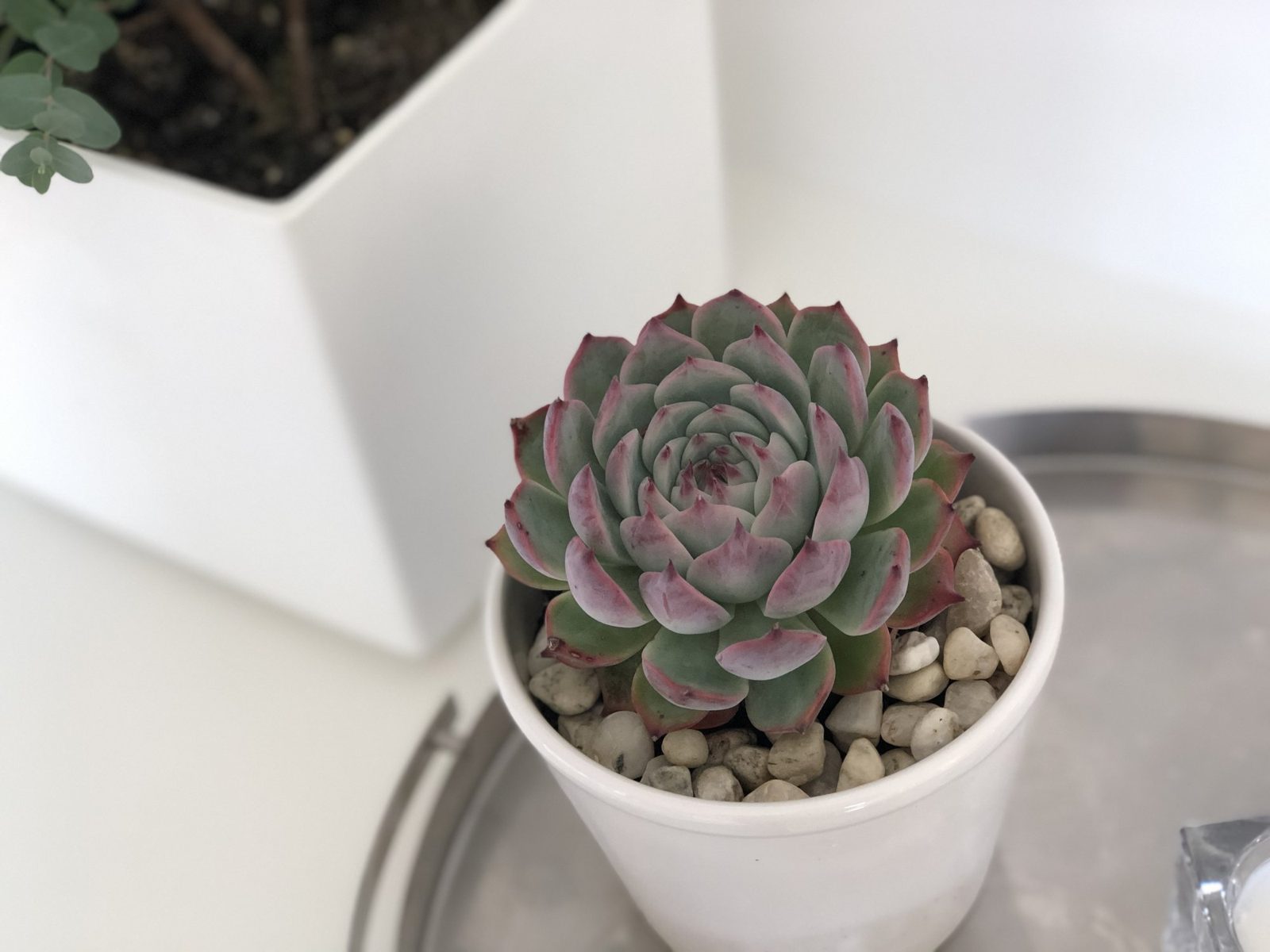
The best slow-growing houseplants that stay small are haworthia, living stones, air plants, echeveria, and bird’s nest snake plant. All of them stay under 20 cm (8 in) tall for years and can live in the same small pot for a long time. Most are succulents, because storing water and growing slowly go together.
A slow plant is a good fit for a desk, a narrow sill, or a shelf with no room to spare. It needs less water, less fertilizer, and almost no pruning. The trade is patience. A damaged leaf takes a long time to replace.
Quick comparison
| Plant | Indoor size | Light | Water | Pet safe |
|---|---|---|---|---|
| Haworthia | 8 to 15 cm (3 to 6 in) | Bright, indirect | When fully dry | Yes |
| Living stones | 2 to 5 cm (1 to 2 in) | Direct sun | Rarely, by season | Yes |
| Air plant | 5 to 20 cm (2 to 8 in) | Bright, indirect | Soak weekly | Yes |
| Echeveria | 5 to 15 cm (2 to 6 in) wide | Direct sun | When fully dry | Yes |
| Bird’s nest snake plant | 15 to 20 cm (6 to 8 in) | Low to bright | When fully dry | No |
| Moon cactus | 8 to 15 cm (3 to 6 in) | Bright, indirect | When fully dry | Yes |
| Bunny ear cactus | 20 to 45 cm (8 to 18 in) | Direct sun | When fully dry | Yes |
| Peperomia | 15 to 30 cm (6 to 12 in) | Medium to bright, indirect | When the top half is dry | Yes |
| African violet | 10 to 15 cm (4 to 6 in) | Bright, indirect | When the top feels dry | Yes |
| Jade plant | Kept small by pot size | Direct sun | When fully dry | No |
| Ponytail palm | Kept small by pot size | Bright | When fully dry | Yes |
The smallest and slowest
Haworthia
Haworthia is a small rosette succulent. Zebra haworthia (Haworthiopsis attenuata) has white bands on pointed leaves. Unlike most succulents, it accepts bright, indirect light, so it does fine on a desk near a window. It is non-toxic to cats and dogs.
Living stones
Living stones (Lithops) look like split pebbles. Each plant is one pair of thick leaves. It makes one new pair a year, and the old pair shrivels away. Watering is the hard part. Do not water while the new leaves are replacing the old ones, and water little the rest of the year. Too much water makes them split or rot. They are non-toxic to cats and dogs.
Air plant
Air plant (Tillandsia) needs no pot and no soil. It takes water through its leaves. Soak it in room temperature water for 20 to 30 minutes once a week, shake it off, and let it dry upside down within a few hours. Most types add only a few leaves a year. It is non-toxic to cats and dogs.
Echeveria
Echeveria forms a tight rosette that looks like a flower. It grows slowly and stays low, as long as it has direct sun. In weak light it stretches tall and thin, and the stretch does not reverse. In a cold-winter climate, a south window or a grow light is a must from November to February. It is non-toxic to cats and dogs.
Bird’s nest snake plant
Bird’s nest snake plant (Dracaena trifasciata ‘Hahnii’) is the short form of snake plant. It grows as a squat rosette about 15 to 20 cm (6 to 8 in) tall. It tolerates low light and long dry spells. It is toxic to cats and dogs and causes drooling and vomiting.
Small cacti
Moon cactus
Moon cactus is two plants joined together. The bright red, orange, or yellow ball on top (Gymnocalycium mihanovichii) has no green pigment and cannot feed itself. It is grafted onto a green cactus base. It barely grows. Grafted plants often live only a few years, since the top and bottom grow at different rates. It is non-toxic to cats and dogs.
Bunny ear cactus
Bunny ear cactus (Opuntia microdasys) grows flat pads in pairs. It adds a few pads a year in good sun. It has no long spines, but the fuzzy dots are tufts of tiny barbed bristles that stick in skin. Handle it with tongs or folded newspaper. It is non-toxic to cats and dogs, but the bristles can hurt a curious nose.
Small leafy plants
Peperomia
Peperomia comes in dozens of types, and almost all stay under 30 cm (12 in). The roots are small and fine, so it lives in a 10 cm (4 in) pot for years. It is non-toxic to cats and dogs.
African violet
African violet (Streptocarpus sect. Saintpaulia) stays a flat rosette about 15 to 30 cm (6 to 12 in) across, and it blooms on and off all year in good light. Miniature types stay under 15 cm (6 in) across. Keep water off the fuzzy leaves, or use a self-watering pot. It is non-toxic to cats and dogs.
Slow plants you can keep small
These two can get large over decades. A snug pot holds them back.
Jade plant
Jade plant (Crassula ovata) grows a few centimeters a year indoors. In a small pot it stays a desk-sized tree for a long time. It is toxic to cats and dogs and causes vomiting and low energy.
Ponytail palm
Ponytail palm (Beaucarnea recurvata) stores water in its swollen base and grows slowly indoors. It only gets large when you move it to a bigger pot. It is non-toxic to cats and dogs.
How to care for slow growers
- Water less than you think. A slow plant uses little water. Most on this list want the soil fully dry before the next watering. Overwatering is the top cause of loss. See how to water succulents indoors.
- Keep the pot small. A big pot holds wet soil the roots cannot use. Go up only 2.5 cm (1 in) in width when you repot.
- Repot rarely. Every 2 to 4 years is common. Fresh soil matters more than a larger pot.
- Feed lightly. Fertilize at half strength two or three times in spring and summer. More does not speed them up.
- Give good light. Slow does not mean low light. Most small succulents need the brightest window in the house.
For more plants that suit a tight pot, see indoor plants that do well in small pots.
Is it slow, or is something wrong?
Slow growth is normal for these plants. No growth at all for a full spring and summer is a sign to check the light and the roots. Almost nothing grows indoors from November to February in a cold-winter climate, so wait for spring before you worry. There is a full list of causes in why is my houseplant not growing.
Which one to pick
- A desk away from the window: bird’s nest snake plant or peperomia.
- A sunny sill: echeveria, living stones, or bunny ear cactus.
- No pot at all: air plant.
- Flowers in a small space: African violet.
- A home with pets: any plant on this list except jade plant and snake plant.
If a pet eats a toxic plant, call your vet or a pet poison line.