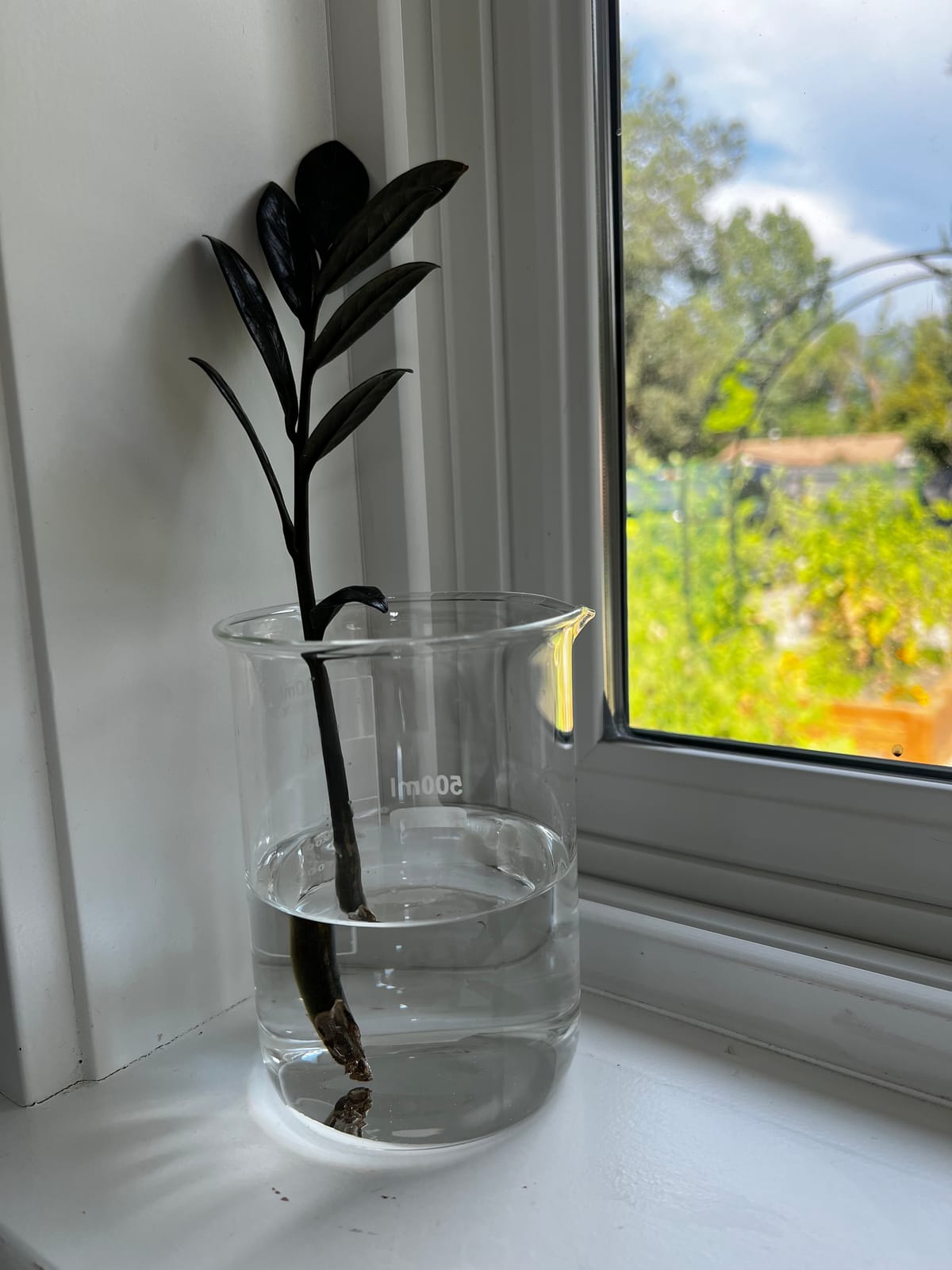
To propagate a houseplant from a cutting, cut a healthy stem just below a node, strip the lower leaves, and put the cut end in water or damp potting mix. Keep it warm and in bright indirect light. Most common houseplants grow roots in two to six weeks.
The node is the key. It is the bump on the stem where a leaf joins. Roots grow from nodes. A cutting with no node will not make a new plant, with a few exceptions listed below.
I earn a commission when you buy through links to Amazon. It costs you nothing extra.
What you need
- Clean, sharp scissors or pruning snips
- Rubbing alcohol to wipe the blades
- A clean jar, or a small pot with a drainage hole
- Fresh potting mix, perlite, or sphagnum moss
- A clear plastic bag (for soil cuttings)
- Rooting hormone (optional)
When to take cuttings
Spring and summer are best. The plant is growing, days are long, and roots form fast. Cuttings taken in a northern winter root slowly and rot more often. If you take them in winter, give them a warm spot and a grow light.
The three kinds of cuttings
| Type | What you cut | Plants |
|---|---|---|
| Stem cutting | A piece of stem with nodes and leaves | Pothos, philodendron, monstera, tradescantia, hoya, rubber plant, fiddle leaf fig, Christmas cactus |
| Leaf cutting | One leaf, or a piece of one | Snake plant, African violet, begonia, peperomia, echeveria, jade plant, ZZ plant |
| Cane cutting | A section of thick, bare stem | Dracaena, dieffenbachia, Chinese evergreen, yucca |
Some plants do not grow from cuttings. Clumping plants such as peace lily, calathea, and most ferns are divided instead. See how to divide a houseplant.
How to take a stem cutting
- Wipe the blades with rubbing alcohol.
- Pick a healthy stem with new growth and no flowers.
- Find a node. Count back from the tip so the cutting has two to four leaves and at least two nodes. Most cuttings are 10 to 15 cm (4 to 6 in) long.
- Cut about 1 cm (1/2 in) below a node.
- Remove the leaves from the lower half. Leave two or three leaves at the top.
- For plants with milky sap, such as rubber plant and fiddle leaf fig, let the cut end dry for an hour. The sap can irritate skin, so wash your hands.
Then root it in water or in potting mix.
Rooting in water
Water is the simplest method for vines. You can watch the roots grow.
- Fill a clean jar with room temperature water.
- Set the cutting in so at least one bare node is under water. Keep all leaves above the water line.
- Put the jar in bright indirect light. Keep it out of direct sun and away from cold window glass.
- Change the water once a week, or sooner if it turns cloudy.
- Wait for roots 2.5 to 5 cm (1 to 2 in) long.
- Pot the cutting in damp potting mix. Keep the soil a little more moist than usual for the first two weeks while the roots adjust.
Do not wait too long to pot up. Long water roots have a harder time adjusting to soil. See which houseplants root in water and how to do it.
Rooting in potting mix
Soil rooting takes away the move from water to soil. It suits woody stems, succulents, and leaf cuttings.
- Fill a small pot with damp mix. Half potting mix and half perlite works for most plants.
- Dip the cut end in rooting hormone powder if you are using it. Tap off the extra.
- Make a hole with a pencil. Set the cutting in so one or two nodes are buried.
- Press the mix gently around the stem.
- Cover the pot loosely with a clear plastic bag to hold humidity. Keep the bag off the leaves.
- Keep the mix damp, not wet.
- After three to four weeks, tug the cutting lightly. If it resists, it has roots. Remove the bag.
Do not bag succulents or cacti. They rot in humid air.
How to take leaf cuttings
Snake plant
Cut a leaf into sections 5 to 8 cm (2 to 3 in) long. Keep track of which end was the bottom. Let the pieces dry for two to three days. Stand them bottom end down in damp cactus mix. Roots and pups take one to three months. Types with yellow edges come back plain green from leaf cuttings. See how to propagate a snake plant.
African violet
Cut a healthy leaf with 2.5 to 4 cm (1 to 1.5 in) of stalk. Push the stalk into damp mix at an angle. Cover with a bag. Small plantlets appear at the base in one to three months.
Succulents
Twist a whole leaf cleanly off the stem. Let it dry for a few days until the end seals over. Lay it on top of dry cactus mix in bright light. Mist the soil lightly once roots appear. See how to propagate succulents from leaves.
ZZ plant
A single leaflet or a whole stem will root in water or soil. It is slow. A ZZ cutting first grows a small swollen rhizome, then roots, and new shoots can take many months.
Cuttings that will not work
- A pothos or philodendron leaf with no node. It may grow roots, but it will never grow a vine.
- A monstera leaf and stalk with no piece of main stem. Same result. See how to propagate a monstera.
- A single hoya heart leaf. It can live for years as one leaf and not grow.
How long rooting takes
| Plant | Time to roots |
|---|---|
| Pothos, heartleaf philodendron | 2 to 4 weeks |
| Monstera | 3 to 6 weeks |
| Rubber plant, fiddle leaf fig | 6 to 10 weeks |
| Snake plant leaf | 1 to 3 months |
| ZZ plant | 2 to 9 months |
Warmth speeds things up. Cuttings root best at 21 to 24°C (70 to 75°F). Move jars back from cold window glass at night.
Why cuttings fail
- The stem turns black and soft. This is rot. The water was stale, the soil was too wet, or the room was cold. Cut above the rot and start again with fresh water or mix.
- The leaves wilt and dry up. The air is too dry or the cutting has too many leaves. Use a bag for humidity, and cut large leaves in half.
Pet safety
Many of the plants that root most readily are toxic to cats and dogs, including pothos, philodendron, monstera, snake plant, ZZ plant, and jade plant. Chewing them can cause mouth irritation, drooling, and vomiting. Keep jars of cuttings out of reach. Call your vet or a pet poison line if a pet eats one.
After the cutting roots
- Pot it in a small pot, 8 to 10 cm (3 to 4 in) wide. A big pot stays too wet.
- Plant three or four cuttings together for a fuller plant.
- Keep it in bright indirect light.
For the most popular starter plant, see how to propagate pothos in water or soil.